
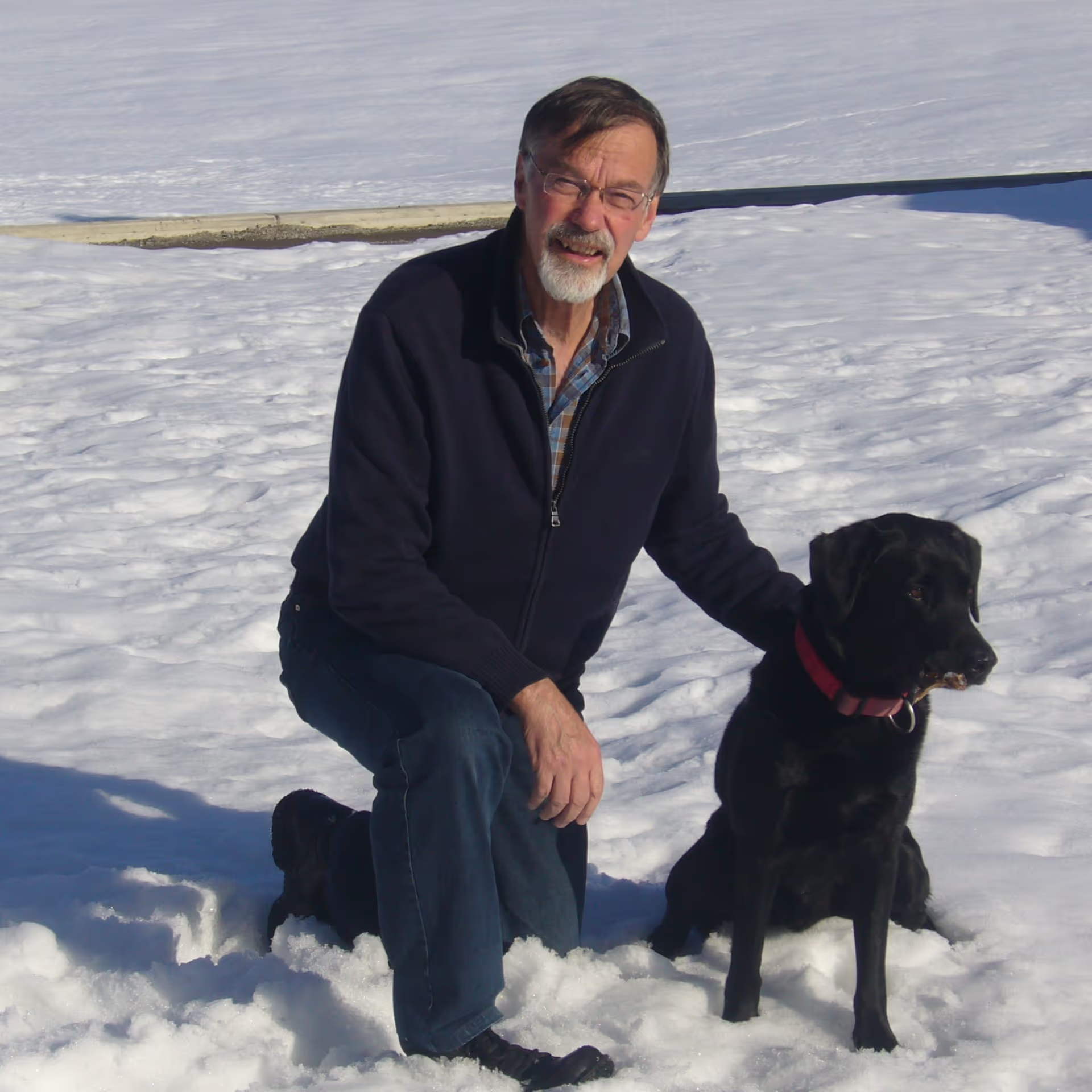
In a career spanning more than five decades, Prof. Dr. Ulrich Kihm has been guided by a philosophy that has shaped both his personal choices and his contributions to global animal health: "You have to be open for anything that comes".
Ueli, as he is known to colleagues worldwide, has followed an extraordinary trajectory: from academic researcher to Director of Switzerland's Federal Vaccine Institute, during his time as Chief Veterinary Officer managing the BSE crisis and leadership roles in international organizations, to founding SAFOSO and TAFS Forum, consistently transforming challenges into opportunities for advancing global animal health.
What makes his story compelling is not just the breadth of his contributions, developing disease control capacity across regions, transforming institutional roles, contributing to international disease control standards, and creating platforms for public-private collaboration, but also his willingness to reinvent his career at pivotal moments.
This interview explores the mindset behind these transitions: a commitment to science-based decision-making, a strong belief inbuilding people's capacity, and the conviction that complex animal health challenges can only be addressed through collaboration between public and private sectors. For professionals navigating their own careers and for anyone interested in evidence-based innovation, Ueli's reflections offer both inspiration and grounded insights into building a meaningful and lasting legacy in animal health.
I was always motivated to improve animal health. In the early 1970s, fresh out of university, I had no clear vision of where my career would lead. I decided to do a thesis on milk production at the cellular level, even though I initially didn't know how to approach it. This led me to explore new methods, including immunofluorescence techniques to demonstrate protein production in epithelial cells of the bovine mammary gland.
These early experiences taught me an important lesson: when existing approaches don’t work, you have to find new ones. This principle stayed with me throughout my career whenever I faced unfamiliar challenges. You have to be open for anything that comes.
The biggest challenge was navigating the transitions between completely different fields. Early in my career, I also briefly tried large animal veterinary practice, but I quickly realised how physically demanding it was and that it wasn’t the right path for me. After my university research, I moved to the former Federal Vaccine Institute in Basel to work on the control of immunobiological products including Foot-and-mouth disease (FMD) vaccines, which was again a completely different field. At the time, most countries had no established system for the registration and control of veterinary immunological products, so we were developing something entirely new.
In January 1975, I was only 30 years old then, the previous director of the institute in Basel became seriously ill and invited me to succeed him. At the time, I did not anticipate that I would lead this institute for nearly two decades, during which it evolved from the Federal Vaccine Institute into what is today known as the Institute for Virology and Immunology (IVI). Based on my professional experience, I had a clear conviction that government institutions shouldn't be producing sophisticated vaccines. We therefore shifted the institute’s focus from FMD vaccine production to vaccine control, diagnostics of highly contagious diseases and to strengthening the capacity of veterinary services for disease control.
Scientific advances in vaccine production and diagnostics have been truly transformative. Using FMD as an example, today's high-quality vaccines benefit from improved inactivation methods, more effective adjuvants, and enhanced purification processes. At the same time, DIVA diagnostic technology now allows us to reliably differentiate infected from vaccinated animals. This means that we can demonstrate absence of virus infection based on evidence, rather than relying on assumptions.
Our science-based approach to decision making has improved considerably, although challenges remain. What remains unchanged is that many people still struggle to understand uncertainty in science. In reality, things in nature are rarely 100% clear-cut. For those who have not worked in scientific environments, this inherent uncertainty can be difficult to grasp and even harder to communicate.
People and organizations are often reluctant to change, preferring to stick to old systems even when new technology makes them obsolete.
Using FMD as an example, in the early 1990s, as president of the FMD and Other Exotic Diseases Commission, I contributed to the development of the international standards of the World Organisation for Animal Health (WOAH, formerly OIE), which introduced two separate categories for FMD freedom: FMD free with vaccination and without vaccination. To demonstrate that freedom from FMD with vaccination was achievable, we implemented a pilot project in Uruguay.
At that time, this distinction was necessary because we lacked the tools to demonstrate serologically freedom from infection in vaccinated populations. Today, however, with high-quality vaccines and diagnostics, we can reliably demonstrate the absence of virus circulation regardless of vaccination status. Yet, reluctance to update these standards still persists.
Even when the necessary tools are available, disease control remains a long-term process. Achieving meaningful progress typically takes many years, often a decade or more, depending on the nature of the disease and the starting conditions.
Success depends on two critical forms of cooperation. First, international collaboration, as diseases do not respect borders. Second, strong commitment and coordinated efforts between public and private sectors. Without both, effective disease control is not possible.
FMD is inherently complex to control, due to factors such as aerosol transmission and the presence of multiple viral strains with a broad host range. At the same time, we live in an increasingly interconnected world, where transboundary animal diseases can spread further and faster than ever. In some regions, additional challenges, such as the wildlife reservoirs further complicate control efforts.
Investment in high-quality vaccines and reliable diagnostic tools is essential, as effective disease control is nearly impossible without dependable tools. However, even when such quality tools are available, success depends on their consistent and rigorous application over time, adapted to local conditions. Therefore, it is essential that all stakeholders receive proper training and can perform their roles reliably.
In addition, many countries face limitations in the capacity of their veterinary services. Through my involvement in many national and regional FMD control initiatives, I've observed that veterinary services are often not sufficiently prepared to implement appropriate measures and are constrained by limited funding, regulatory barriers, or lack of support from the private sector.
I served as Chief Veterinary Officer of Switzerland and Head of the Federal Veterinary Office for ten years (1993-2003). During this time, I always had fundamental question: why should animal disease control be the responsibility of the public sector alone? I was convinced that the private sector must also play an important role, provided it has the necessary training and support.
When I left government, I faced an important choice: after many years of experience in animal health and food safety, should I simply retire? Instead, I saw an opportunity to transfer my knowledge to others and demonstrate that private sector approaches could be both effective and impactful. This conviction led me to establish SAFOSO in 2003.
After more than two decades of global projects serving both public and private clients, SAFOSO continues to thrive. Building such a unique company required tremendous dedication from all our colleagues, combined with flexibility and creativity. Our journey has shown that private sector approaches to disease control are not only viable, but an essential complement to public sector efforts to address global animal health challenges.
During the BSE crisis, I was serving as Chief Veterinary Officer of Switzerland and Head of the Federal Veterinary Office. Much like the COVID-19 pandemic, BSE dominated public attention and media coverage.
When scientists first claimed that the disease was caused by an infectious agent without DNA or RNA, I was sceptical. It challenged everything we thought we knew about pathogens. However, I quickly accepted that we were facing something fundamentally new. As we now know, the breakthrough was the removal of specified risk materials, such as spinal cord and brain tissue, from the food and feed chain.
More broadly, this crisis highlighted a critical gap: the need for clearer and more effective communication of scientific evidence, particularly in situations of uncertainty. Traditional communication channels between government and the private sector and to the public proved insufficient for managing such a complex and evolving threat.
In the public sector, you benefit from stable resources, but decision-making can be constrained by administrative processes and political challenges. In the private sector, there is greater flexibility, but also the need to generate revenues. Both systems have their strengths and their limitations. What became clear to me is that neither sector can address complex disease control challenges on its own. Stronger collaboration is essential.
My international experiences, particularly with the BSE crisis, reinforced this view and ultimately led me to establish the non-profit TAFS Forum, alongside SAFOSO. The idea was to create an independent platform where scientific evidence could be translated into practical insights and shared effectively between scientists, government officials, industry leaders and the public.
Don’t limit yourself to what is expected. I built my career by focusing on livestock population health rather than individual animal treatment, which was not the typical path for veterinarians at the time.
Many young professionals underestimate the versatility of our profession. A background in animal health can open doors in government, research, international organizations, and private sector, often in ways they may not initially consider.
Be open to unexpected opportunities and have the courage to explore them
Always be open to what comes. Throughout my career, I've learned that success requires flexibility and the courage to pursue new opportunities, even when they involve uncertainty. Not every idea will succeed, and setbacks are part of the process.
Perhaps most importantly is the role of collaboration. The challenges we face in animal health are too complex for any one person or institution to solve alone. When working with others, it is essential to be modest and put the issue at the centre, not individual perspectives. Focus on the objective you want to achieve, rather than personal positions.
The education and continuous training of all stakeholders is the key to success.
Finally, all decisions should be grounded in science and evidence. Understanding and communicating why we do what we do is fundamental to effective and responsible decision-making which is accepted by the general public.
Combining the courage to take risks with the ability to collaborate meaningfully is what ultimately makes the journey both successful and rewarding.
Every six weeks, the newsletter provides a summary of relevant articles as well as our viewpoint on the news.
The newsletter is free and without obligation. You can unsubscribe from the distribution list at any time.


